Test purchasing for underage gambling is coming to Irish betting shops. A young-looking person walks in and tries to place a bet, and the shop either stops them or it does not.
At the counter, most shops are ready for it. Staff work to Challenge 25: if a customer looks under 25, ask for ID. It is not easy. A busy counter, a queue, a customer who will be annoyed at being asked, and the temptation to let the borderline case go to avoid an argument. But there is a person there, and they are trained.
The self-service terminals are another matter.
The blind spot
Some shops in Ireland have 25 or 30 self-service betting terminals, and a self-service payout machine besides. A customer can walk in, stake, collect and leave without ever coming to the counter.
The same member of staff who is meant to keep an eye on all of those screens is also taking bets, translating slips, counting cash, and working through a checklist that runs from the float to the toilets. Expecting them to judge the age of everyone at every terminal is not a plan. It is a hope.
The check at the screen
SentinelGate puts a camera on the terminal. When someone steps up who looks younger than the shop’s challenge age, the terminal locks and asks them to see a member of staff.
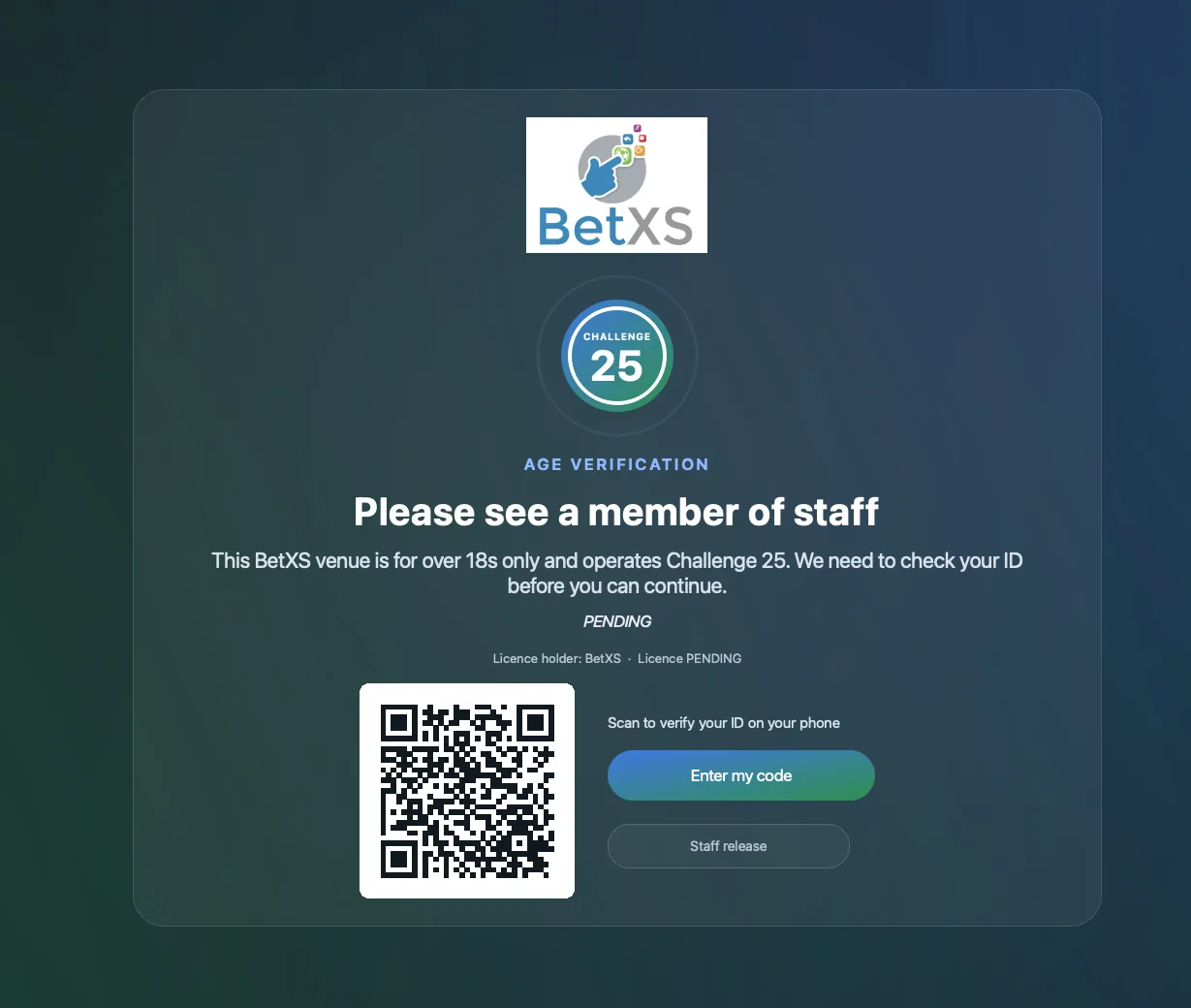
They go to the counter and show ID, the way they would if they were betting there. Staff check it and unlock the terminal with a PIN. The customer goes back and carries on.
If the shop switches it on, the lock screen also shows a QR code. The customer scans it and asks for a code on their phone. Once the shop’s staff have checked their ID, they send the code with one press, and the customer types it in at the terminal. The code works at every one of the operator’s terminals for 24 hours, so a customer who has been checked once is not sent back to the counter at every screen.
The camera does not decide that anyone is under age. Estimating age from a face is approximate, so SentinelGate does what a good member of staff does: it asks. The person behind the counter makes the call.
How often it asks
Estimating age from a face is approximate, and the challenge age is a trade. Raise it and more under-18s are asked for ID, but so are more adults: mostly the youngest of them, which is what Challenge 25 intends. Lower it and fewer adults are troubled, but more under-18s get through. The shop chooses where that line sits.
There are limits a shop should know about:
- A face the camera cannot see clearly gets no estimate, and so no check: one that is too small, turned too far away or blurred.
- One glance is not enough. Several estimates of the same person have to agree before a terminal locks, so a single bad frame does not lock anyone out.
- Some 17 year olds look older than they are, to a camera as to a person behind the counter.
So SentinelGate is not a guarantee, and we do not sell it as one. It is a check at screens that today have none.
Measured by someone else
How often it asks should not rest on our word, or on figures we produce ourselves. Two independent checks are next.
NIST. The US National Institute of Standards and Technology runs an open test of age estimation software, FATE Age Estimation and Verification. It runs a developer’s software on its own photographs, whose ages are known to the day and which include children, and publishes the results under the developer’s name, including how often 17 year olds are taken for 25 or over. We plan to submit SentinelGate’s age model. NIST is clear that its test is not a certification and sets no pass mark. It is an independent measurement, and the result will be public whatever it says.
ACCS. We have started the certification process with the Age Check Certification Scheme. Certification checks that a system does what its maker says it does. So it starts with a written statement of exactly that: what the system does, how accurately, and how it handles security and privacy, with evidence behind every claim. We are writing ours now.
What it takes
- A camera on each terminal. An ordinary USB webcam will do.
- A small piece of software running on the terminal itself.
- A challenge age you choose. It defaults to 25. In our own demonstration we set it to 45, which locked out a grey-haired member of our team.
- A PIN for staff to release a terminal once they have seen ID.
Private by design
A camera that looks at every customer’s face has to earn its place. So SentinelGate is built for the most private set-up to be the default one, and every step away from it is a switch the shop turns on knowingly.
It all happens on the terminal. Faces are found and ages estimated on the terminal’s own processor, not in the cloud. Video is held in memory and never written to disk. SentinelGate accepts no connections from outside, and it keeps working if the shop’s internet goes down.
A customer who looks old enough leaves no trace. They see nothing at all. No picture of them, no measurement of their face and no estimate of their age is kept, not even as a line in a log, and our tests check exactly that.
A lock keeps very little. The record says that an age check was raised, on which camera, when, and what staff decided. It never holds the customer’s estimated age or a picture of them. Staff can see the face in question for at most two minutes, from memory, so they know whom to ask. The shop can set that to none.
Nothing has to leave the shop. There is no central database of faces. By default, nothing about a customer leaves the terminal at all. The rest is off until the shop switches it on, and every switch is written to the audit log:
- sending alerts to the shop’s own systems, with or without a picture of the face;
- release codes by phone, where the customer chooses to give us a first name and a mobile number;
- reporting to our central server, so that one enrolment can work across every shop.
It does one job. It does not count customers, time how long they stay, or guess anything else about them. It compares an estimate with the challenge age, and then forgets it.
Data that is never collected cannot be lost or misused. Looking at customers’ faces is still a serious thing to do, however little is kept, and it should start with a data protection impact assessment. We work through it with you.
A check at every terminal
The counter will always depend on a person, on a good day and a bad one. The terminals do not have to. With a camera at each screen, the customers staff would never have seen are asked the same question as the ones at the counter.
If you would like to see SentinelGate on one of your terminals, talk to us and we will show you.